Flooded Car in Durham, NC? What To Do Before You Turn the Key
Heavy rain in the Triangle can turn a street into a creek in minutes. Low spots near creeks, underpasses, and storm drains collect water fast, and every year drivers around Durham misjudge a flooded road and end up with a stalled, waterlogged car. What you do in the first few minutes decides whether the damage stays repairable or turns into a total loss.
The most important rule: do not try to restart a car that has been in flood water. Starting a waterlogged engine can turn a repairable problem into a destroyed engine. Call for a flatbed tow instead.
If Your Car Is Still in Rising Water
Your life matters more than the car. If water is rising around you, get out. Moving water is more powerful than it looks, and it takes surprisingly little to push a vehicle off a road.
- Unbuckle and open the window or door right away, while the electrics may still work
- If the doors won't open against the water pressure, lower the window and climb out; don't wait for the cabin to fill
- Move to higher ground and away from the water, not along the flooded road
- Call 911 if you or anyone with you is in danger
- Never walk or wade through moving water, even if it looks shallow
Why You Should Never Restart a Flooded Engine
Water doesn't compress. If it gets into the intake and reaches the cylinders, the engine can try to squeeze it as the pistons rise, a failure called hydrolock. The result can be bent connecting rods and a cracked block, which often costs more than the car is worth. Even a few seconds of cranking can do it. Water can also reach the transmission, the differential, and the electronics, and pushing the car through more water to get it out can make all of that worse.
That's why the safe sequence is: stop, don't restart, and have the car moved without running the engine. If the water only reached the lower body or tires, you may be lucky, but you can't know that from the driver's seat.
Once You're Safe, Do This
- Take photos and video of the water line on the car and the surrounding conditions before anything is moved; your insurer will want proof
- Note the date, time, and exact location where the car was flooded
- Turn the ignition off and, if you can do it safely, disconnect the negative battery cable to reduce the chance of electrical damage
- Keep the car out of further water; don't push or roll it into deeper puddles
- Open your insurance app or call your insurer promptly to start a claim
Why a Flatbed Is the Right Tow for a Flooded Car
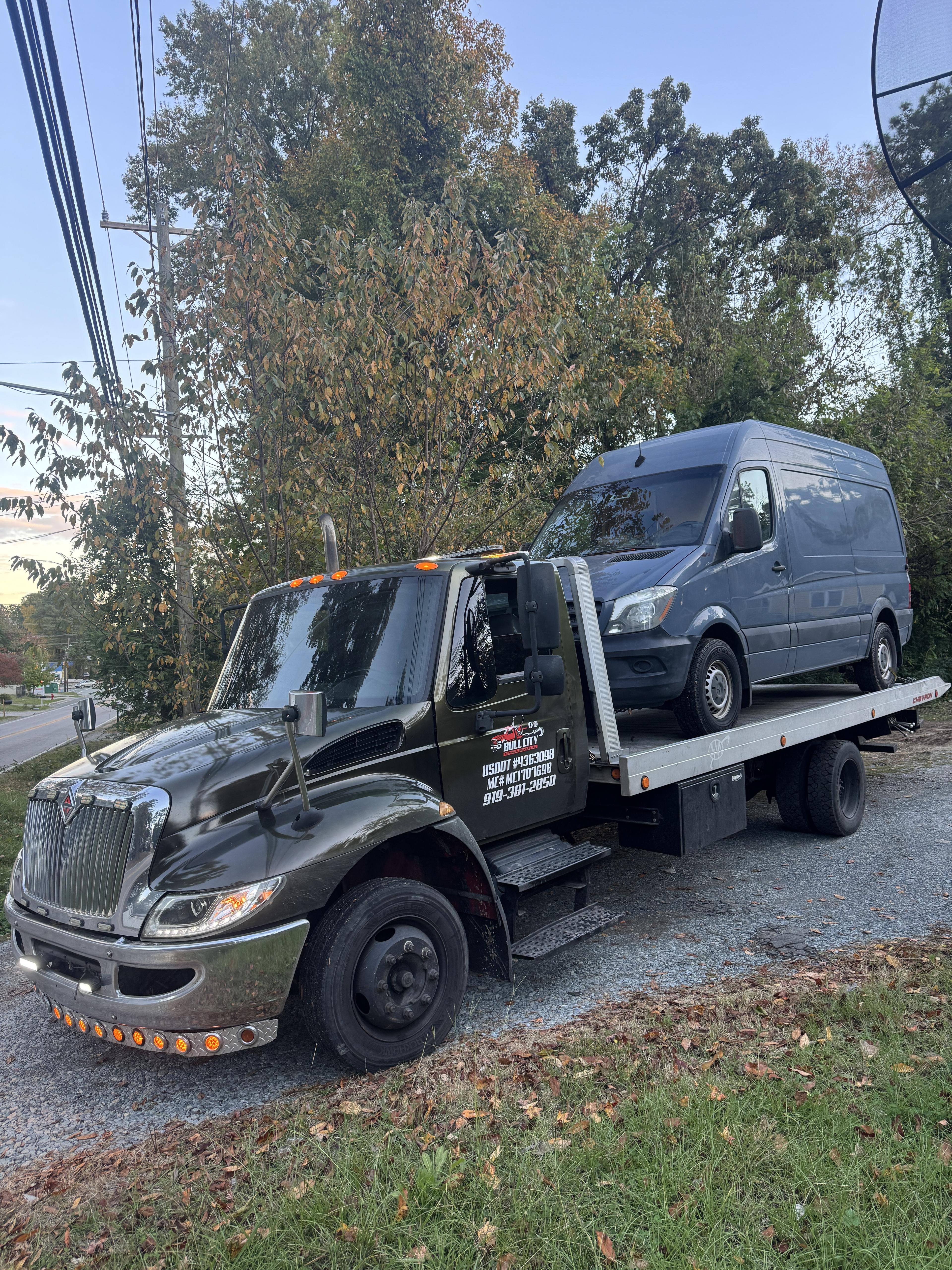
A flooded vehicle should be moved with all four wheels off the ground. Rolling it on a wheel-lift can spin a transmission and axles that may be full of water and short on lubrication. Hybrids and electric vehicles are even more sensitive, since high-voltage components and wheel-connected motors don't tolerate being turned or powered after water exposure. A flatbed moves the car without running any of its systems, which protects what's left to repair.
A flatbed with a winch can also pull a car that won't roll out of a flooded low spot, so you aren't relying on the engine or the drivetrain at all.
Choose Where the Car Goes
After a storm, tow trucks you didn't call often show up near flooded roads offering quick help. You are not obligated to accept. You have the right to choose your own towing company and your own destination, whether that's a repair shop, a dealership, or your home. Tell the dispatcher you want it taken to a specific address, ask for the price before the truck rolls, and keep your receipt for the claim.
What to Expect From Insurance
Flood damage is typically covered under the comprehensive portion of an auto policy, not basic liability. Coverage varies, so check your own policy. Insurers often send an adjuster, who may decide the car can be repaired or declares it a total loss. Early photos, a clear timeline, and towing receipts all help. If you need to move the car before the adjuster arrives, document it first.
Signs a Flooded Car Is Hiding More Damage
- A musty smell or visible dampness in the carpet, seats, or headliner
- Fogged headlights or taillights with moisture inside
- Silt or debris in the trunk, under the seats, or in the glove box
- Warning lights that flicker or electronics that act erratically
- Rust forming quickly on bolts, seat rails, or under the dash
These matter if you ever buy a used car, too. Flood-damaged vehicles sometimes get cleaned up and sold, so a vehicle history report and a pre-purchase inspection are worth the effort.
Prevent It Next Time
- Never drive into water if you can't see the road surface; turn around instead
- Avoid low spots, underpasses, and roads near creeks during heavy rain
- Remember that a foot or two of water can float or stall many cars
- Check road closures and radar before heading out in a storm
Frequently Asked Questions
Can I drive my car after it was in a flood?
If it stalled in the water, no. Don't restart it. Have it towed to a shop for inspection first. Even if it seems to run, hidden damage to the electronics, transmission, and fluids can appear later.
How fast can a tow truck get to a flooded area?
It depends on road conditions. Storms spike call volume across the Triangle, and some roads may be closed. A local company that dispatches its own trucks can give you a realistic ETA on the phone and route around closures.
Will my car be a total loss?
Not necessarily. Outcomes depend on how deep the water got and how fast the car is handled afterward. Cars that were only splashed through shallow water often recover. Cars with water inside the cabin or the engine usually need a full inspection and a professional assessment.
Car stuck or stalled in flood water in Durham or the Triangle? Don't restart it. Call Bull City Towing at (919) 381-2850. We answer 24/7, quote the price upfront, and move your car on a flatbed to the shop you choose.
Need a tow truck in Durham?
We answer 24/7. No voicemail, no waiting.
More from Bull City Towing
Ran Out of Gas in Durham, NC? What To Do and Who To Call
6 min read · November 3, 2026
Tips & SafetyCheck Engine Light On in Durham, NC? When It's Safe to Drive and When to Call a Tow Truck
6 min read · October 25, 2026
Tips & SafetyHow To Prepare Your Car for a Tow: What To Do Before the Truck Arrives in Durham, NC
5 min read · October 25, 2026